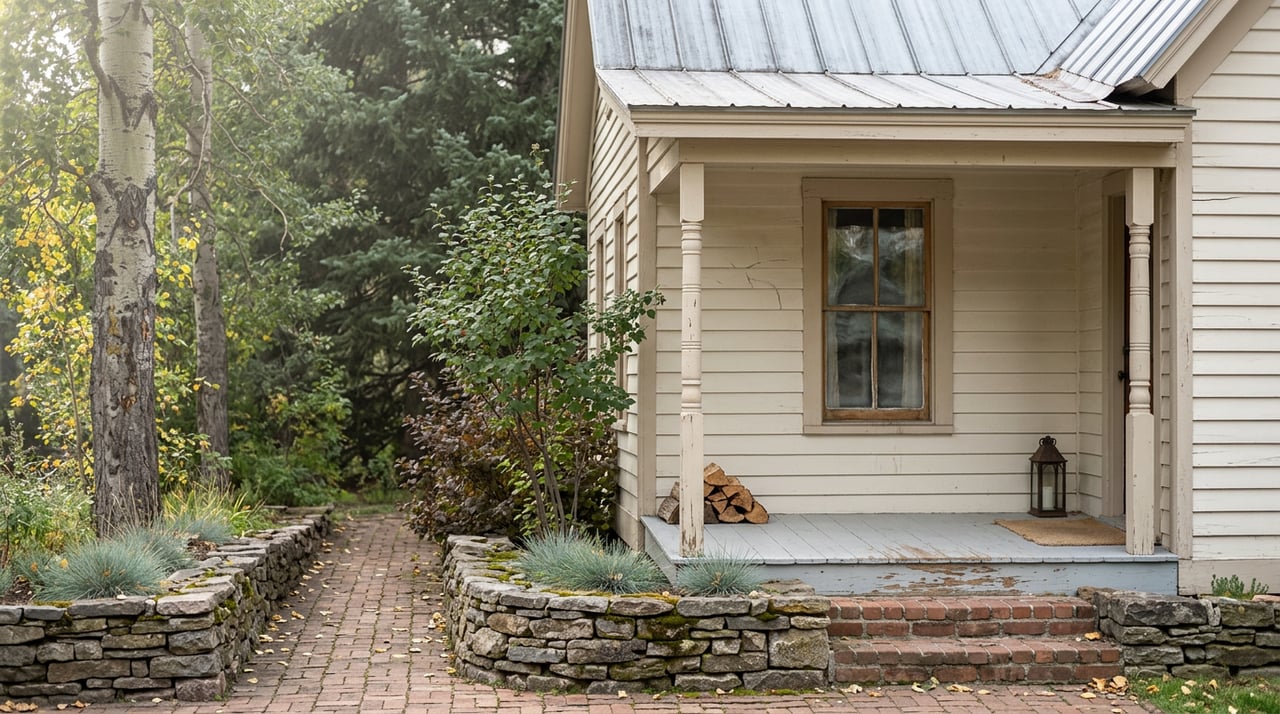
A buyer who closes on a restored Victorian a block off Colorado Avenue owns the house outright the moment the deed records. What that buyer does not own outright is the right to change it. Repaint the trim a different color, replace a failing section of dry-stacked stone wall, swap out the picket fence along the sidewalk, and Telluride's Historic and Architectural Review Commission has a say before the Town's building department will issue a permit for any of it.
That sequencing, approval before permit rather than the other way around, is the detail that a listing photo or a price-per-square-foot comparison never surfaces. Telluride earned its National Historic Landmark District designation in 1961, recognizing the town's mining-boom-era architecture from 1878 to 1913, and that status attaches a review obligation to nearly any exterior project within the district, not just the ones that involve a wrecking ball.
The Approval Comes Before the Permit
The mechanics are straightforward once you know them, and easy to miss if you don't. The Historic and Architectural Review Commission, known locally as HARC, is directed to issue a Certificate of Appropriateness before the Town will process a permit for the erection, demolition, moving, renovation, restoration, addition to, or alteration of any structure or sign within the historic overlay.
Only after that certificate is in hand does the project move to the next stage: a Building Permit Application filed online through the Town's SmartGov portal, followed by inspections scheduled through that same system. HARC is a quasi-judicial commission, which means its decisions on individual applications carry the same procedural weight as a court ruling on the matter before it. It typically meets the third Wednesday of the month, and the full year's meeting calendar is set before the calendar year begins, so the review cadence is fixed well in advance rather than scheduled around any single buyer's timeline.
The Fence Counts as Much as the Facade
The part that catches most buyers off guard is scope. Telluride's design guidelines define a building's character broadly: not just its shape and materials, but its craftsmanship, decorative details, interior spaces, and the various aspects of its site and environment. That last phrase is doing real work. The guidelines call out dry-stacked rock retaining walls and fences by name as features that help convey how people lived in Telluride during its formative decades, and they note that even the way a building is positioned on its lot is considered historically significant. Destroy those secondary features, the Town's own guidance states, and the ability to read a property's historic character is diminished even if the house itself is untouched.
In practice, this means a buyer cannot treat a Victorian's stone retaining wall or perimeter fence as a landscaping decision separate from the house. It is part of the same regulated fabric, subject to the same certificate requirement as a new addition.
What the Current Docket Shows
This is not a dormant rule that only surfaces in old code books. As of April 2026, HARC had a public hearing scheduled for a property at 208 S. Fir, one of several applications moving through the process this year. Other projects on the Town's 2025-2026 docket illustrate how long that process can actually run: a proposal tied to the Tomboy parcel appeared before the commission in October 2025, was continued to December 2025, continued again to February 2026, and remained on the agenda into March 2026. A separate application for 566 W. Columbia followed a similar path, moving from a November 2025 hearing to January 2026 and again to March 2026. A third property, 214 S. Fir, carried from December 2025 into January 2026 before resolution.
None of that is unusual by HARC's own operating rhythm. It is simply what "review before permit" looks like when a project has enough design complexity to warrant more than one look. A buyer evaluating a historic property should read that pattern as the realistic timeline for anything beyond cosmetic maintenance: months of monthly hearings, not a single afternoon at the building counter.
How This Shapes an Offer
Telluride's broader housing market is thin enough that timeline friction matters more than it would somewhere with deeper inventory. The median sale price in the town of Telluride reached $4.7 million over the three months ending May 2026, up 27 percent from the same period a year earlier. That headline number rested on very little volume. Only one home sold in Telluride in May 2026, down from four the year before, which is a reminder that in a market this small, a single closing can swing the median substantially in either direction.
That scarcity cuts both ways for a buyer weighing a historic property. There is rarely a deep bench of comparable homes to fall back on if a renovation stalls in review, which raises the practical cost of misjudging the HARC timeline. It also means a buyer should treat the design-review sequence as a real, if unpriced, part of ownership cost rather than a footnote to read after closing. The Town's guidelines are explicit that demolition within the historic overlay is discouraged in favor of rehabilitation and reuse, so a strategy built around tearing down and starting over is unlikely to move smoothly through the process even when the land itself is valuable.
What Working Within the System Looks Like
None of this means historic properties are unworkable, only that the work happens on the Town's calendar rather than the buyer's. Bob Mather, who served as Telluride's historic preservation architect, once described the purpose of the Town's awards program as a way to "recognize projects that showed outstanding commitment to historic preservation and compatibility" with the district's character. That program, established in 2008, continues to run each year. Its 2025 cycle judged nominations against the Secretary of the Interior's rehabilitation standards and Telluride's own design guidelines.
A handful of local projects show what compliance looks like when it goes well. Finbro Construction's rehabilitation of the First National/Nugget Building earned the firm its third historic rehabilitation award from HARC, work the company describes as some of the most rewarding it takes on in the landmark district. At 200 S. Oak St., an award-winning rehabilitation for owners William and Lynnette Gray, designed by Kristine Perpar Architect and built by Hoins Construction, involved a new foundation, reuse of the home's existing stone veneer, additional framing, and restoration of the original windows and siding. Contractor Scott Andrews of Telluride Trading & Construction has picked up multiple HARC Preservation Awards over the years, including for a rehabilitation at 316 N. Oak that, in his own words, "required a lot of problem solving."
The pattern across all three: architects and contractors who already understand the review sequence, and who plan a project's scope around it from the start rather than discovering it mid-permit.
What This Means If You're Comparing Homes
A price per square foot tells a buyer what a historic home looks like today. It says nothing about what it costs in time to change anything about it tomorrow. Anyone comparing a move-in-ready Victorian in the historic district against new construction elsewhere in San Miguel County should weigh the HARC sequence as a genuine variable, not a formality to handle later. Before writing an offer, it is worth confirming a property's precise status against the Town's own Historic Structures Map and Treatment Area Map, and worth having a conversation with a contractor or architect who has already carried a project through this specific process, since the names that keep appearing on the Town's award list are not a coincidence.
Frequently Asked Questions
Does HARC review apply to every home in Telluride? No. It applies specifically to properties within the Historic Preservation Overlay District. The Town maintains a Historic Structures Map that identifies which parcels fall inside that boundary, and it is worth checking before assuming a property is or is not subject to review.
How long does a Certificate of Appropriateness typically take? It varies with scope. Straightforward applications can clear in a single monthly hearing, but the Town's own 2025-2026 public record shows more complex projects moving across three or more consecutive monthly meetings before final action.
Are secondary features like stone walls and fences really reviewed the same way as the house? Yes. Telluride's design guidelines specifically name dry-stacked rock retaining walls and fences as character-defining features of the historic district, alongside the primary structure itself.
Can a historic home simply be torn down and replaced? The Town's guidelines discourage demolition within the overlay district and direct property owners toward rehabilitation and reuse instead, which makes a full teardown strategy difficult to move through review even on a desirable lot.
Buying or selling a home inside Telluride's historic district is not simply a real estate transaction. It is a design-review relationship that starts the day you close and continues every time you touch the exterior. Alan Cook has worked construction and real estate in this market since 1992, long enough to know which architects and contractors already speak HARC's language and which timelines are realistic before an offer goes in. If you are weighing a historic property in Telluride against other options in the San Juan Mountains, reach out today to talk through what the process actually involves before you're the one on next month's agenda.